Apoquel Big Itch


Is Your Dog Showing Signs of a Skin Condition?
Occasional scratching can be normal—but frequent or persistent itching means it’s time to schedule a veterinary evaluation.
Signs to watch for:
|
• |
Frequent scratching, licking, chewing or biting |
|
• |
Scooting or head shaking |
|
• |
Red or inflamed skin |
|
• |
Hair loss or bald patches |
|
• |
Recurring skin or ear infections |
|
• |
Changes in sleep, play or other normal activities |
What Could Be Behind Your Dog’s Itch?
Potential causes include:
|
• |
Environmental or seasonal allergies |
|
• |
Food allergies |
|
• |
Fleas, mites and other parasites |
|
• |
Skin infections |
|
• |
Contact with irritating substances |
Your veterinarian may review your dog’s health history, perform a physical exam and recommend testing to help determine the cause.

Certain dog breeds have a greater likelihood of developing itchy skin due to allergic itch. Knowing if your dog is one of the breeds prone to allergic itch helps you take a proactive approach to prevention and care.
There are two types of prolonged itch — seasonal and chronic (year-round). If your dog has been scratching, scooting, or shaking more frequently, they may be suffering from an itch-inducing condition.
Watching your dog scratch or chew themselves can be stressful for any pet parent. Learn more about the reasons your dog is itching despite medication.
If your dog is constantly scratching it's important to understand how dog gut health and allergies are connected (and what you can do) to help your dog feel comfortable and happy.

• Starts treating allergic itch within 1 day1,2
• Lasts for 4 to 8 weeks1,2
• A long-lasting injection your vet gives your dog every 4 to 8 weeks1†,2
Ask your vet if Cytopoint is right for your dog.

• Provides rapid relief for allergic itch within 4 hours3‡,4
• Controls itch within 24 hours5,6
• Available as a chewable for ease of dosing (given with or without food)
Talk to your vet about Apoquel Chewable.

Some parasites affect the skin, while others can pose broader health risks—sometimes without obvious signs. Year-round prevention helps protect your dog against parasites that can cause itching, digestive issues, weight loss and more.
Simparica TRIO® (sarolaner, moxidectin & pyrantel chewable tablets) can help. One monthly chewable tablet protects against heartworm disease, ticks, fleas, roundworms and hookworms.
Earn points on participating Zoetis product purchases and redeem them for products or services at your veterinarian.
Join PetCare Rewards
Occasional scratching is normal. Frequent, persistent or intense scratching may signal an underlying skin condition.
Contact your veterinarian if the itching persists, interrupts your dog’s sleep or usual activities, or is accompanied by redness, hair loss, sores, swelling, odor or recurring ear problems.
Cytopoint is an injection administered by your veterinary care team, while Apoquel is an oral treatment available as a traditional tablet or chewable.
Your veterinarian can recommend an option based on your dog’s needs.
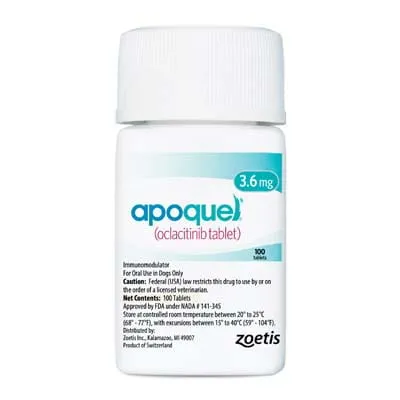
Apoquel and Apoquel Chewable contain the same active medication and treat the same types of allergic itch. The difference is the form: Apoquel is a traditional pill that is swallowed, while Apoquel Chewable is a tasty, chewable option that may be easier to give.
Some allergies and skin conditions require ongoing management. Your veterinarian will recommend a treatment and follow-up schedule based on your dog’s response.
Brought to you by Zoetis
*Get $50 off two Cytopoint injections when purchased together. One offer per pet. Injections must be used within 6 months of purchase. Cannot be combined with other promotions.
Offers expires on December 31, 2026.
†Based on a model study for flea allergic dermatitis.
‡Repeat administration every 4 to 8 weeks as needed in the individual patient.1
References:
1. Michels GM, Ramsey DS, Walsh KF, et al. A blinded, randomized, placebo-controlled, dose determination trial of lokivetmab (ZTS-00103289), a caninized, anti-canine IL-31 monoclonal antibody in client-owned dogs with atopic dermatitis. Vet Dermatol. 2016;27(6):478- e129. doi:10.1111/vde.12376.
2. Data on file, Study Report No. C166R-US-17-180, 2018, Zoetis Inc.
3. Data on file, Study Report No. A162R-US-21-C32, Zoetis Inc.
4. Gadeyne C, Little P, King VL, et al. Efficacy of oclacitinib (Apoquel®) compared with prednisolone for the control of pruritus and clinical signs associated with allergic dermatitis in client-owned dogs in Australia. Vet Dermatol. 2014;25(6):512- e86, doi:10.1111/vde.12166.
5. Data on file, Study Report A161C-US-21-C02, 2022, Zoetis Inc.
6. Cosgrove SB, Wren JA, Cleaver DM, et al. Efficacy and safety of oclacitinib for the control of pruritus and associated skin lesions in dogs with canine allergic dermatitis. Vet Dermatol. 2013;24(5):479-e114. doi:10.1111/vde.12047.
Indications
Cytopoint has been shown to be effective for the treatment of dogs against allergic dermatitis and atopic dermatitis.
Apoquel and Apoquel Chewable Important Safety Information
Do not use Apoquel or Apoquel Chewable in dogs less than 12 months of age or those with serious infections. Apoquel and Apoquel Chewable may increase the chances of developing serious infections, and may cause existing parasitic skin infestations or pre-existing cancers to get worse. Consider the risks and benefits of treatment in dogs with a history of recurrence of these conditions. New neoplastic conditions (benign and malignant) were observed in clinical studies and post-approval. Apoquel and Apoquel Chewable have not been tested in dogs receiving some medications including some commonly used to treat skin conditions such as corticosteroids and cyclosporines. Do not use in breeding, pregnant or lactating dogs. Most common side effects are vomiting and diarrhea. Apoquel and Apoquel Chewable have been used safely with many common medications including parasiticides, antibiotics and vaccines.
See Full Prescribing Information
Simparica Trio Important Safety Information
Use with caution in dogs with a history of seizures. Simparica Trio contains sarolaner, a member of the isoxazoline class, which has been associated with neurologic adverse reactions including tremors, ataxia, and seizures in dogs with or without a history of neurologic disorders. The safe use of Simparica Trio has not been evaluated in breeding, pregnant, or lactating dogs. The most frequently reported adverse reactions in clinical trials were vomiting and diarrhea.
See Full Prescribing Information
Librela Important Safety Information
See full Prescribing Information at https://librelapi.com. For use in dogs only. Women who are pregnant, trying to conceive or breastfeeding should take extreme care to avoid self-injection. Hypersensitivity reactions, including anaphylaxis, could potentially occur with self-injection. Librela should not be used in breeding, pregnant or lactating dogs. Librela should not be administered to dogs with known hypersensitivity to bedinvetmab. The most common adverse events reported in a clinical study were urinary tract infections, bacterial skin infections and dermatitis.
See Full Prescribing Information
Cytopoint, Apoquel, Apoquel Chewable, Simparica Trio, and Librela are the property of Zoetis Services LLC or a related company or a licensor unless otherwise noted.
All other trademarks are the property of their respective owners.